

Ruben Dargã Holdorf
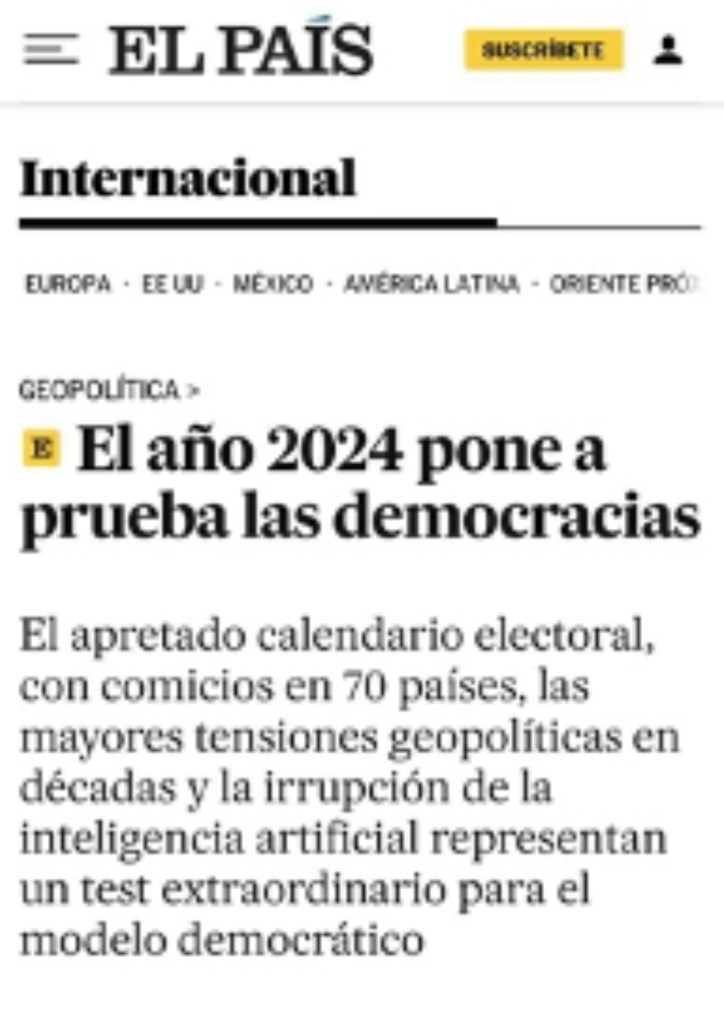
On April 6th, 2021, the Colombian newspaper El Mundo, from Medellín, launched a “last cry” (último clamor), ending its activities as a result of what they labeled as the “virus of ignorance,” the foolishness of personalities willing to silence the uncomfortable voices of the press. A headline from the Spanish newspaper El País, dated December 31st, 2023, predicted democracy being put to the test in 2024, considering that the elections would involve almost half of the world’s population this year. Furthermore, in many countries there has been a setback in the democratic process since the coronavirus pandemic. Some of these nations opted for regimes with authoritarian tendencies, as a result of military coups or maneuvers orchestrated by leaders no interest in respecting voters’ choices.
If there has been a deterioration in collective and, mainly, individual freedoms, does this mean other political regimes are trying to occupy the space of a decadent democracy? It is necessary to present some definitions of this regime in force in most of the West and sparsely in other regions to get an answer. The democracy seems to be approaching its end as a majority political regime in the last eight decades. Are the institutions or powers that support it also crumbling in the face of the series of accelerated changes that have occurred in the most diverse areas? Given a new scenario, the rise of three supranational powers appears with the intending to take advantage of the vacuum and try to establish another political order, employing and disfiguring the very tripod that nourished democracy until now.
For preparing this article, the corpus used as a parameter refers to media productions since 2020, both textual and video, from the United States, Europe, and notably, Brazil. The analyzes of the narratives develop based on the conception of the Theory of Discourse Engineering, whose structure verifies journalistic activities and the impact of textual constructions on the solidification or dismantling of the democratic regime. Until 2013, expressive conservative ideological thinking predominated in the newsrooms of the most important Brazilian journalistic outlets. However, this inclination of the press weakened the democratic regime by assuming a right-wing partisan role, practically non-existent at the time, giving way to more radical forces, contrary to individual freedoms, to fill the vacant space of power.
The deaths of Mussa José Assis, former editorial director of O Estado do Paraná news; Ruy Mesquita, from O Estado de S. Paulonews; Roberto Civita, from Abril publishing, in 2013; Domingo Alzugaray, from IstoÉ magazine, in 2017; and Otávio Frias Filho, from Folha de S.Paulo news, in 2018, opened a void in the Brazilian press, leaving space for a new generation linked to the dissemination of ideologies derived from marxism. Despite certain connections with right-wing ideologies, few press outlets consider themselves independent, such as the Gazeta do Povo and Zero Hora digital news, and O Antagonista, Crusoé, and Oeste magazines. On the international scene, The New York Timesthey tipped the ideological balance to the left after the death of Arthur Ochs Sulzberger in 2012.
Between 1995 and 2010, watchwords praising the importance of democracy in the Brazilian press were subtle and little explored, including condemning the trends of the progressive left. From the second decade of the 21st century onwards, “democracy” appeared gradually, with increasing frequency in discourses, and increasingly spread across all parts of the planet.
Thoughts about democracy
In the most common context, it is enough to have free elections for democracy to exist. However, democracy is not limited to offering open elections to citizens, but has other characteristics. If this simple concept were restricted to the popular vote, Cuba and Venezuela could also be considered full democracies despite the suspicions regarding the honesty of these votes.
When making considerations about democracy under the sole parameter of free elections, Tzvetan Todorov defines it “as a set of characteristics that combine to form a complex arrangement, within which they limit and balance each other” (original text in Brazilian-portuguese: “por um conjunto de características que se combinam para formar um arranjo complexo, em cujo seio elas se limitam e equilibram mutuamente”). Guillermo O’Donnell recognizes the existence of freedoms as other characteristics, for which he defends the establishment of fair internal limits.
To have mutual trust between voters and government officials, Ernesto Laclau points out as a determining peculiarity the absolute transparency of the actions of representatives installed in the Executive and Legislative Powers. After all, the democratic regime presupposes, according to Wilson Gomes, the people exercising the government and not a portion of the citizens. To this end, Todorov raises a warning signal if the powers that be disrespect the long-awaited balance.

Following the exacerbated externalization of the battle between extreme ideologies, public figures also began to try to redefine the idea of democracy through the media, whether journalistic or social. In an interview with Gaucha Radio Station, president Luís Inácio Lula da Silva considers the concept of democracy to be “relative,” as “Venezuela has more elections than in Brazil” (“Venezuela tem mais eleições do que no Brasil”). He admires the democracy that led him to the presidency on three occasions, although he feels proud when they label him a “communist”. Unlike the president, the minister Luís Roberto Barroso, current president of the Supreme Court (STF), includes Venezuela in the group of authoritarian nations, such as Hungary and Russia, in which “people do not feel well represented, they do not feel they have voice and relevance in the current arrangement and therefore become easy prey to authoritarian and populist discourses”.
The former publisher of Grupo Estado, Fernão Lara Mesquita, believes that, in a democracy, “the people rule the government, and not the other way around”. On his channel, the journalist Luís Ernesto Lacombe accuses the press of defending authoritarian leaders under to justify of saving democracy.
Democracy is not imposed but accepted. Naturally, the democratic regime improves over time as challenges emerge before society. When the term’s meaning becomes a distorted watchword spread by the press, uninformed citizens opt for other orthodox powers. At the “nodal point” of the discourse, the watchword calls its audience to action.
Democracy’s support
Step by step, democracy is melting or eroding around the world, underlined Minister Barroso. Collective rights are undermined, and individual rights are ignored and ridiculed. This not only concerns Iran, North Korea, China, Russia, Cuba and Venezuela, where freedom has not existed for a long time, but also possible risks for the European Union, United States, Australia, New Zealand, Israel and, of course, Brazil.
The lie has become the truth, and the truth is considered “fake news”, a watchword distorted from the original context. The “fake news” has become so powerful that any comment contrary to or judgment on the global paranoia of stunned governments takes the form of falsification and discredit. Dissenting voices are stereotyped as enemies, critics, and disseminators of fabricated news. Either you agree with this outrageous and uncontrollable stupidity, or you place yourself in the line of fire of the arrogant and labeled as politically correct owners of a supposed “truth” that has never been proven.
The ability to mobilize the masses through watchwords paves the way for the press’ irresponsible engagement with fantasies that cause regional and global social, political, and economic collapses. Just remember “The State is me” (L’etat c’est moi), “Work frees” (Arbeit macht frei), “American dream” (the American way of life), “Always for victory,” “In the name of democracy,” “Hope conquered fear,” “It was the biggest terrorist attack in history,” “Arabs attack, Israel answers,” “Stay at home.” Today’s watchwords are “anti-democratic acts,” “coup actions,” “democratic rule of law,” “fundamentalist danger,” “genocide,” and other expressions that shape the picture of shame and intellectual obscenity.
According to José Moisés, democracy is based on the solidity of public institutions, such as political parties, parliaments, and governments. Add to this list the mediator, ombudsman, and all instances of the Judiciary and unions, according to a progressive vision of other authors. However, there are institutions are contributing much more than these spheres mentioned to the maturation of democracy: Education, Justice, and the Press.

Not even natives of the stronghold of contemporary democracy anymore believe in this political regime, as The Washington Post found in “American democracy is cracking”. In the Southern Hemisphere, Lacombe points precisely to Education, the Judiciary, and the “old” Press as co-participants in the democratic collapse by employing outright lies, censorship, and distortion of facts. Thus, the West can be seen demolishing the institutions that protected democracy.
(Mis)Education and ideologization
The education system in many Western countries has exchanged education, as character building and value formation, for party political ideology and unbridled profit. In other cases, it simply ignored its importance on the socioeconomic basis, making it irrelevant, given the data provided by the Programme for International Student Assessment (PISA), coordinated by the Organization for Economic Cooperation and Development (OECD), with the paltry results of governments that prioritize other actions.
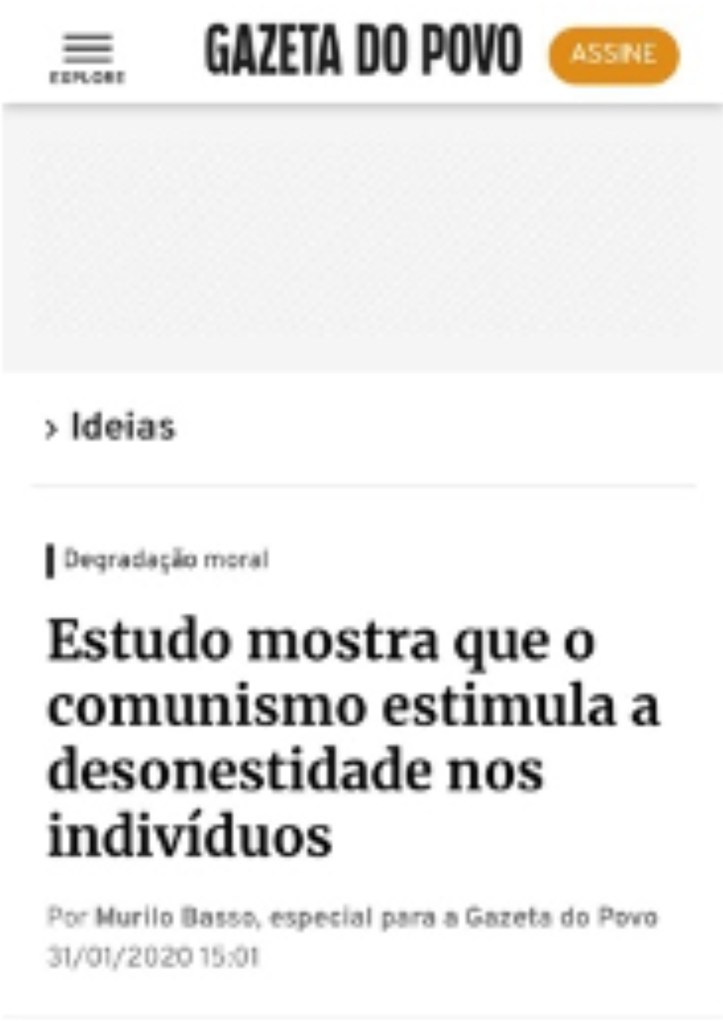
Researchers compared the measure of honesty between Germans born in West Germany (capitalist) and East Germany (communist). The Gazeta do Povo news reproduced the results of the study, revealing that “communism encourages dishonesty in individuals,” leaving a legacy of immorality. In the same sequel, Revista Oeste criticized the guide “Standards for Sexuality Education in Europe: guidance for implementation,” from the World Health Organization (WHO), which encourages masturbation in children between 4 and 6 years old.
Through a documentary on its YouTube channel, The Epoch Times Brasil denounces the influences of the educational system, the press and social media as they contribute to creating of fear and doubt in children regarding their biological sexuality. These issues are treated as “normal”, making this term the watchword. Gender ideology has become the Other-enemy to fight, as it corrodes the educational system and, by extension, morality and the conservative traditional family of religious values.
Data collected by the United Nations Development Programme (UNDP) in partnership with the Federation of Industries of the State of Rio de Janeiro (Firjan) reveal that only 60.3% of students will complete the education cycle by the age of 24 and that annually, more than half a million pupils over the age of 16 abandon their studies in Brazil. The Correio Braziliense news points to socioeconomic vulnerability as the main reason for school dropout, including the need to work without qualifications and the almost impossible access to the best educational institutions and technology. Without valuing and maintaining this column, democracy becomes an object of doubt regarding the effectiveness of equal opportunities for all who seek full knowledge. The watchwords then establish a boundary line between democracy and the Other-student, ideologized and miseducated.
(In)Justice and distortions
The judicial organizations exchanged honesty, public safety, individual, and collective rights for the corrupt interests of judges, prosecutors, public defenders and judicial attorneys. A judicial dictatorship is gradually being installed on many continents, the “Illiterate Lawyer’s Empire,” in which values are inverted.
In “Return of Lula and the judicial threat to Brazil’s Democracy,” the enunciator of The Wall Street Journal describes how the newly elected president managed to get out of prison with the help of the Supreme Court, whose power represents a risk to democracy by planning to block the National Congress. With proposals seeking to restrict the freedom of expression of the press, the STF became the target of a complaint with the Organization of American States (OAS) after approving an opinion holding journalistic companies responsible for the statements made by those interviewed, contradicting the Brazilian Constitution itself. For columnist and lawyer Luís Francisco Carvalho Filho, “not even the dictatorship (military, 1964-85) was as ambitious as the STF”.
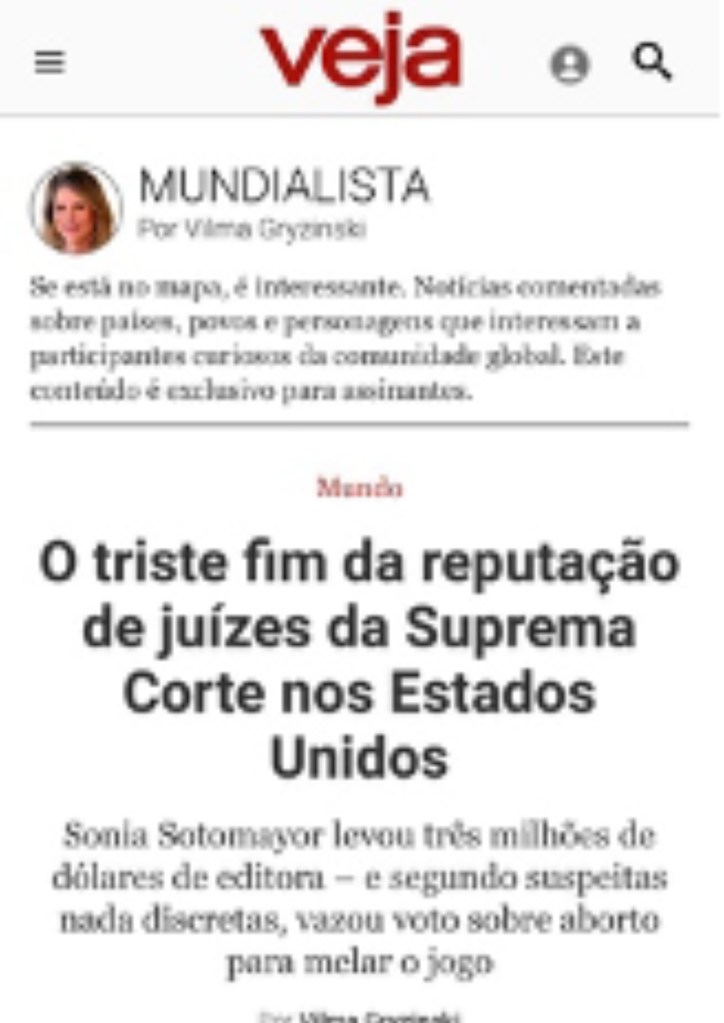
About the highest judicial bodies in other countries, Veja magazine exposes “The sad end of the reputation of USSupreme Court justices” by detailing the suspicious million-dollar inflows in the bank accounts of two members. The World Justice Project measures the Rule of Law Index. Regarding restrictions on government bodies, Denmark, Norway, and Finland lead the list of countries that respect the separation of powers, at the same time Egypt, Nicaragua, and Venezuela occupy the position of authoritarianism and disrespect for institutions. Norway, Denmark, and the Netherlands top the list of civil justice impartiality, leaving Bolivia, Venezuela, and Cambodia in last place in this judicial category. Finland, Denmark, and Norway hold the top spots in the criminal justice impartiality ranking, while Cameroon, Bolivia, and Venezuela remain at the bottom.
The main attributes assigned by the press to justice have a negative polarity, highlighting “corruption”, “political alliances”, “ideological contamination”, “escalation of fear”, and “distortion of the democratic concept”.
Press without credibility
When destroy the credibility of the press – or it implodes itself –, the State itself starts to persecute the remaining and independent journalists, and also encourages the dismantling of the academy that prepares professionals for journalism. From then on, everything disappears, and any stimulus to critical thinking becomes impossible.
Almost three decades ago, James Fallows condemned North American journalistic practices, accusing them of undermining the press’s credibility and, by extension, devastating society. In Brazil in the 21st century, Lacombe blames the mainstream press for supporting those who push the country towards the precipice. But the watchword related to the decline in journalism’s credibility goes beyond borders.

The NGO Honest Reporting denounced photojournalists from the Associated Press (AP), and Reuters agencies, as well as The New York Times and CNN for teaming up with Hamas terrorists. The aim them was to exclusively record images of the atrocities committed against the Israelis. On his YouTube channel, Brazilian actor Sílvio Matos blames the press for associating with governments interested in publicizing and imposing their ideologies on the population. A study promoted by Syracuse University shows only 3.4% of North American journalists confess to identifying with right-wing parties. According to the survey “The American journalist under attack”, 60.1% perceive journalism as heading in the wrong direction.
When depending on advertising revenue, journalism has forgotten its social mission over time, making mistakes, failing to reinvent itself, and suffering a metastatic disease that helped erode democracy. When the press depreciates the Another, it weakens its credibility. “How the media construct, invent, idealize, create, nurture and summon their audiences,” so “leads contemporary, or post-modern, society to question the role of the media.” The delegitimization of journalistic activities contributes to the crumbling of democracy.
Supranational powers
The press provides evidence of powers or supranational governments whose influence corroborates the decline of democracy. These powers accumulated incomparable wealth throughout centuries and also, they keep going inducing, persuading and threatening any power and institution that becomes an obstacle to their intentions. The United States surpasses everyone, whether through diplomatic convergence, accumulation of resources, military measures, or cultural diffusion. Following closely behind, China and its Marxist-Maoist playbook, already deepened in Asia, Africa, and Latin America, is rapidly approaching. Occupying third place on the podium stands the European Union, susceptible to another power emerging in its bowels.

The Economist, from London, clarify its editorial philosophy with values such as independence and integrity. It has opened sections dedicated exclusively to the United States since the Second World War, and strangely enough to China since 2012. The enunciator recognizes the growing Chinese interference nowadays. For the Spaniard Borrell, the rivalry between North Americans and Chinese will determine world politics, as “given everything that’s happening in the world and the rise in authoritarian powers, it is important to have strong cooperation with like-minded democracies.” However, another emerging power in European territory maintains diplomatic relations with 184 countries, the last three established in 2023 with Kazakhstan, Oman, and Vietnam. The Italian daily Corriere della Sera reports the possibility of the Vatican and the Chinese re-establishing relations after seventy years, trusting in the intermediation of Cardinal Matteo Zuppi between the United States and China, the latter being a supposed decisive interlocutor to balance the geopolitical and try to stop Russian aggression against Ukraine. In Brasil de Fato, the enunciator echoes the Russian desire to dialogue with the Vatican. However, Metropolitan Svyatoslav Shevchuk, of the Ukrainian Greek-Catholic Church, in an interview with Roman Kravets, guarantees that Russian diplomacy is in full swing aligning itself with pope Francis.
Although the United States represents a Protestant society in its twilight, China is the standard bearer of communism and exacerbated authoritarianism. The Vatican carries the banner of the Christianity in international political ascendancy and moral decline, the discourses demonstrate boundary lines that still have deep roots. The media enunciators do not deny the existence of these powers in the journalistic making. Instead, they would consent to and support his interference through a global government, a cosmocracy. Even the Brazilian president defends global governance, as stated by Correio Braziliense.
In short
Suddenly, magistrates, professors, journalists, and parliamentarians became “democracy experts.” It’s laughable to see amateurs trying so hard to explain the indefinable. It sounds like American diplomacy, which claims to promote democracy worldwide. Or even more pathetic, the former East Germany, which called itself a “Democratic Republic” within a communist cesspool. Democracy is not forced, it is not promoted, it is simply embraced, otherwise it cannot be called “democracy.” It is necessary to read between the lines of journalistic narratives to detect the purposes of textual constructions.
When self-proclaimed leaders do not learn to dialogue in a civilized way, the impetus of decrees and authoritarian judicial force establishes a police state of terror, the final measure of the violence of dehumanized ideologies. The fact is, for media enunciators, that a global society with the aid of supranational powers can threaten democratic regimes and individual freedoms.
The ideological extremes prove to be harmful to democratic institutions. There is no problem in encouraging your audiences to become politicized. Due to the nature of their job, journalists are politicizers, but they should never assume the status of partisans, ideological activists. Everyone’s problem with partisanship is resolved at the ballot box, freely and secretly, and not by manipulating the fourth power or allowing yourself to be frightened.
The narratives in newspapers, magazines, television networks, social networks, institutional and influencer discourses highlight the watchword, drawing attention to the advancement of an apparent “democracy”, even without knowing what will replace it.
Ruben Dargã Holdorf
Former associate professor in Brazil, and full-time professor in Ukraine.
Doctorate in Communication and Semiotics (Comm.Se.D) from the
Pontifical Catholic University of São Paulo (PUC-SP).
Your CV can be accessed through the Lattes Platform:
http://lattes.cnpq.br/9023786250983747
PS: The original article with it’s complete references can be accessed by link https://journalspress.com/LJRHSS_Volume24/Emergence-of-Supranational-Powers-Melts-the-Political-Regime-of-Freedoms-Media-Views-Regarding-the-Shake-up-of-Democracy.pdf


Leave a Reply